Chair Pose

Chair Pose: Step-by-Step Instructions
Chair Pose (Utkatasana) is excellent for building strength in your thighs and stretching out stiff shoulders.
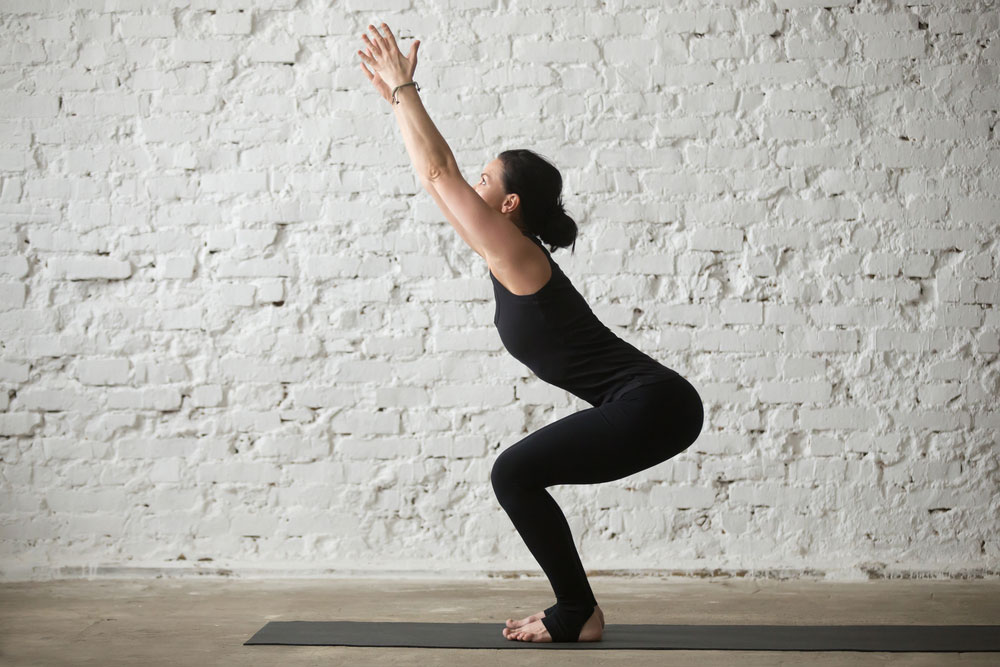
Utkatasana
(Pronounced as "oot-kah-TAHS-anna")
In Sanskrit, utkata means "fierce" or "powerful." Here you build stamina quickly by sitting on an imaginary chair.
How to Do Chair Pose
Follow these step-by-step instructions to safely enter, hold, and release Chair Pose with proper alignment.
| Step | Key Action | Focus Point |
|---|---|---|
| 1 | Stand in Tadasana, raise arms overhead | Shoulders back and down, palms joined |
| 2 | Bend knees, lower hips | Thighs parallel to floor, weight on heels |
| 3 | Tuck shoulder blades, extend spine | Tailbone points down, arms fully extended |
| 4 | Hold for 30+ seconds, then release | Breathe normally, straighten knees to exit |
Step One
Stand up straight in Tadasana. Your feet are together, legs straight, chest lifted, shoulders rolled back and down. On an inhalation, raise your arms up straight above the head so that your fingers point toward the ceiling. Keeping your shoulders back, extend up and join your palms together.
Step Two
As you exhale, bend your knees down until the tops of your thighs are parallel to the floor. If you cannot descend this far, hold the position at the point where you've bent down as far as you can.
While descending, keep your chest lifted with your arms behind your ears. Although your arms will want to come forward, keep pushing them back and extending them up.
The knees will extend in front of the feet somewhat, and your torso does lean slightly forward. However, the goal is to form a right angle between your thighs and torso. Keep your feet flat on the floor with your weight more on your heels.
Step Three
Tuck your shoulder blades firmly into your back to give your arms the support they need to extend up fully in the air above you. Extend your back up all the way from the tailbone through the tops of your fingers.
Your tailbone should not curve back; rather, the tailbone elongates and points down toward the floor.
Step Four
Breathe normally. Hold this position for 30 seconds. As you become more proficient in this posture, you can gradually practice holding it for longer periods of time.
Inhale as you straighten your knees to come out of the pose. Exhale as you drop your arms back down to your sides in Tadasana once more.
Beginner's Tip:
When you first learn this pose, try it against a wall. Keep pressing your back against the wall as you slide down until your thighs are parallel to the floor.
Position your feet so that they are directly underneath your knees. Press your heels down firmly into the floor and rest your hands on top of your thighs to make sure your thighs stay level. Use your thigh muscles to keep pushing into the wall.
Do not let your back come away from the wall. Straighten your legs and slide back up the wall when you have held it for as long as you can.
Chair Pose Information
Understanding the background, contraindications, and modifications for Chair Pose will help you practice safely and effectively.
| Detail | Information |
|---|---|
| Sanskrit Name | Utkatasana |
| Pose Level | Level 1 (Beginner) |
| Primary Focus | Thigh and core strength, shoulder flexibility |
| Hold Duration | 30 seconds to 1 minute |
| Key Cautions | Recent knee/ankle injuries, lower back inflammation, irregular blood pressure |
Sanskrit Name:
Utkatasana
Pose Level:
Level 1
Contraindications and Cautions:
Knee, ankle, or foot injuries less than two months old
In case of muscle inflammation in the lower back, practice it against a wall as described above.
Irregular blood pressure
Chronic headaches or insomnia (practice with caution and shorter hold times)
Modifications and Props:
To help train your thigh muscles to support you more, place a yoga block in between your thighs just above your knees. Squeeze the block tightly with your legs as you bend down into Chair Pose.
Deepen the Pose:
The secret to holding your balance in Chair Pose is to keep your weight on your heels without letting your chest collapse forward. One way to achieve this is to press your palms together behind your back in Namaskar position as you hold Chair Pose.
This way, your hands force your chest to stay lifted and open while you restrain your shoulders from caving forward.
You can also hold your elbows behind your back with your hands if you can't press your palms together behind your shoulder blades.
Chair Pose Benefits
Chair Pose delivers a range of physical benefits, particularly for the lower body and core. Consistent practice strengthens key muscle groups while improving posture and balance.
| Benefit | Area Targeted |
|---|---|
| Tones and strengthens muscles | Ankles, calves, thighs, and spine |
| Stretches and expands | Chest and shoulders |
| Stimulates and massages | Abdominal organs, heart, and diaphragm |
| Improves balance and stability | Core and lower body |
| Builds endurance and stamina | Full body |
Tones the muscles in your ankles, calves, thighs, and spine
Stretches and expands your chest and shoulders
Massages the abdominal organs, heart, and diaphragm
Improves overall balance and builds lower body endurance
Chair Pose Variations
Once you are comfortable with the standard Chair Pose, explore these variations to challenge your balance and deepen your practice.
| Variation | Description | Difficulty |
|---|---|---|
| Raised Heels Chair Pose | Lift onto the balls of your feet, sit buttocks on lifted heels, arms extended forward parallel to the floor | Intermediate |
| Revolved Chair Pose (Parivrtta Utkatasana) | Add a spinal twist by bringing palms together at the chest and rotating the torso to one side | Intermediate |
| One-Legged Chair Pose | Cross one ankle over the opposite thigh while in Chair Pose for added balance challenge | Advanced |
Lift yourself up on the balls of your feet while bending your knees. Then sit down with your buttocks on your lifted heels. Stretch your arms forward to balance, keeping your arms parallel to the floor.
Partnering:
As you practice Chair Pose, ask a partner to help press your heels down into the ground using their hands.